Sorry, I almost forgot the dinner music:
Showing posts with label Caro-Kann. Show all posts
Showing posts with label Caro-Kann. Show all posts
Tuesday, March 13, 2012
You call it a Caro Kann...
Yeah, you call it a Caro Kann, but I call it a BDG. Fresh from yesterday’s TWIC, for your dining pleasure:
Sorry, I almost forgot the dinner music:
Sorry, I almost forgot the dinner music:


Monday, August 1, 2011
Back to back
How do you explain it? A player has a great tournament one month, a dismal one a month or two later. Nakamura triumphs spectacularly at Wijk aan Zee and a few months later struggles to avoid last place at Dortmund. What is it? What’s the difference? Concentration? Confidence? Fate? Luck? It happens everywhere. Teams go on winning streaks (and losing streaks). Batters go on hitting streaks. Golfers, racing car drivers, best selling novelists, all succeed or fail in streaks.
Yes, simple woodpushers, too. By the time I took up chess I had a family and work that allowed little time for weekend tournaments. They were usually so few and far apart that I came to consider two games won in row a winning streak. Here’s an example from thirty years ago, when my work involved so much travel that I probably got in no more than a couple of tournaments a year. The games were played back to back, one with white, one with black. And each was blessed with a rook sac down the beloved f-file.
Tuesday, November 9, 2010
Win One, Lose One
A couple of Blackmar-Diemers turned up in this week's TWIC. White wins an Euwe Defense transposition from the Caro Kann, but loses a Teichmann. Oh, well...
(Use the pull-down menu to get to the second game)
(Use the pull-down menu to get to the second game)
Friday, July 3, 2009
Milner-Barry Gambit in the Caro-Kann
Here’s an interesting game from last week’s TWIC. It’s a Milner-Barry Gambit, a line in the Caro-Kann that more often than not evolves into a BDG or BDG-like positions. I’m pressed for time right now, but will have some comments on this game and a few more like it in the next day or two.
Meanwhile, Happy Independence Day!
Koenig,Ch (2140) - Oosterman,M (2005)
3rd ENCI Limburg Open Maastricht NED (3), 30.05.2009
Caro-Kann, B15
1.e4 c6 2.d4 d5 3.Nc3 dxe4 4.f3

4...g6 5.fxe4 Bg7 6.Be3 Nf6 7.Nf3 Ng4 8.Bg1 Nd7 9.h3 Ngf6 10.Qd2 b5 11.a3 0-0 12.Bh2 Bb7 13.e5 Ne8 14.Be2 Nb6 15.0-0 Nc7 16.Ne4 Ne6 17.Rad1 a6 18.b3 h6 19.c4 Rc8 20.Qe3 Qc7 21.Rd2 Rfd8 22.Rfd1 Ba8 23.Kh1 Qa7 24.Bg1 Nd7 25.a4 Qb7 26.axb5 cxb5 27.d5 Nec5 28.Nxc5 Nxc5 29.Nd4 Qc7 30.Bh2 Qa5 31.Bg4 e6 32.dxe6 fxe6 33.b4 Qxb4 34.Nc2 Qa5 35.Rxd8+ Rxd8 36.Rxd8+ Qxd8 37.Qxc5 Kh7 38.Qd6 Qg5 39.Qd4 h5 40.Bf4 Qh4 41.Bxe6 bxc4 42.Kh2 Qe7 43.Bxc4 Qb7 44.Ne3 a5 45.Qd8 1-0
Meanwhile, Happy Independence Day!
Koenig,Ch (2140) - Oosterman,M (2005)
3rd ENCI Limburg Open Maastricht NED (3), 30.05.2009
Caro-Kann, B15
1.e4 c6 2.d4 d5 3.Nc3 dxe4 4.f3

4...g6 5.fxe4 Bg7 6.Be3 Nf6 7.Nf3 Ng4 8.Bg1 Nd7 9.h3 Ngf6 10.Qd2 b5 11.a3 0-0 12.Bh2 Bb7 13.e5 Ne8 14.Be2 Nb6 15.0-0 Nc7 16.Ne4 Ne6 17.Rad1 a6 18.b3 h6 19.c4 Rc8 20.Qe3 Qc7 21.Rd2 Rfd8 22.Rfd1 Ba8 23.Kh1 Qa7 24.Bg1 Nd7 25.a4 Qb7 26.axb5 cxb5 27.d5 Nec5 28.Nxc5 Nxc5 29.Nd4 Qc7 30.Bh2 Qa5 31.Bg4 e6 32.dxe6 fxe6 33.b4 Qxb4 34.Nc2 Qa5 35.Rxd8+ Rxd8 36.Rxd8+ Qxd8 37.Qxc5 Kh7 38.Qd6 Qg5 39.Qd4 h5 40.Bf4 Qh4 41.Bxe6 bxc4 42.Kh2 Qe7 43.Bxc4 Qb7 44.Ne3 a5 45.Qd8 1-0
Sunday, May 31, 2009
Black Blunders in the Blackmar
by Niels Jørgen Jensen
Over the years Niels Jørgen Jensen, of Copenhagen, contributed many articles and games to BDG World. Here is his first article we published, from the January/February issue of our third year, 1985.
We all know that if we let our opponent face a BDG we are more likely to finish him off quickly and brutally than if we play another opening, say the Queen's Gambit. Why is that so? What is it in the BDG that literally provokes our opponent to commit blunders? Well, to a certain extent it can be explained.
If we accept the fact that blunders do not appear totally haphazardly, it becomes clear that the answer must be closely connected to psychology. Chess is a mental struggle, and so chess blunders must be looked upon as psychological phenomena. Let us take a look at various categories of black faults and try to explain them. First, a game as study material:
Niels Jørgen Jensen - Steen Lynesskjold
Team Match, 1984
BDG (from Caro-Kann)
1.d4 d5 2.e4 Here my opponent sighed, "Blackmar-Diemer," thought for about five minutes, shook his head determinedly and played: 2...c6 3.Nc3 dxe4 4.Bc4 Nf6 5.f3 And now he realized that he had been fooled. Ten minutes thought. 5...exf3 6.Nxf3

6...e6 [Some people just don't play the obvious: 6...Bf5 ] 7.0-0 b5 8.Bd3 Nbd7 9.Qe1

Preparing for Qg3 or Qh4. I wouldn't develop my Bc1 until Black had had his chance to misplace his Bf8. 9...Be7 10.Ng5 b4 11.Nce4 a5 12.Nxf7 Kxf7 13.Ng5+ Ke8 14.Qxe6 Rf8 15.Nxh7 1-0
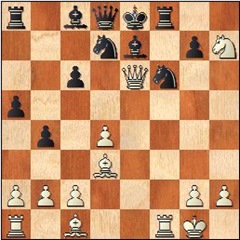
As you will admit, Black defended poorly. However, he is no weak player, and his weak moves do not occur incidentally but--as we shall see--can be psychologically explained.
In his excellent book, Psychology in Chess, the Russian GM Krogius distinguishes between three different types of blunders, which are all present in the above game:
1. The forward image occurs when the player transfers positions reached in his calculations or moves which have not yet been played to the actual position on the board. As Krogius expresses it: “The future possibilities become an obsession and are treated as real factors in the assessment of the current position.” Thus the player in whom a forward image has arisen tends to exaggerate threats. In the game above, the move 6…e6? is the result of such a forward image. Black knows that the BDG is a very sharp opening, he may fear a Bxf7+, and in his imagination he already sees an overwhelming attack with Ng5+ and Qf3--moves which in his mind are accepted as real. Perhaps he also sees the "ghosts" 6…Bg4? 7.Ne5 or 6…Bf5 7.0-0 followed by Ng5/Nxf7/Rxf5. At any rate, he decides on the "safe" 6…e6?, preventing the impossible sacrifice on f7. If you search your BDG literature (Freidl II, e.g.), you will find several similar moves, indicating that we are dealing with a common psychological pattern.
2. The retained image is the opposite of the forward image. Whereas the forward image leads to exaggerations of future possibilities, the retained image tends to narrow down the perception of the chess player, who plans his moves from a starting point which has become static, thus repressing the dynamic aspects of the position.
I think Krogius's retained image should be divided into two distinct subcategories:
Denmark, 1984
Lemberger Counter Gambit
1.d4 d5 2.e4 dxe4 3.Nc3 e5 4.Nxe4 Qxd4 5.Bd3 Nc6 6.Nf3 Qb6 7.0-0 Bg4 8.h3 Bxf3 9.Qxf3 Nd4 10.Qh5 Bd6 11.Be3

11...Qc6? 12.Bxd4 exd4 13.Bb5 1-0
The blunder 11 … Qc6? can only be explained by the second type of the retained image: the e5-pawn firmly separates the Qh5 from the crucial square b5 and blocks Black's imagination of the possibilities after a possible removal of the pawn.
3. Krogius's third category of faults arises from the recalled inert image. This image may arise when a player, trying to carry out a plan, fails to realize that the position on the board might have changed in a way which was not foreseen. The player fails to notice the dynamic powers of the position. Again as a first example my game above; after having played 6 … e6, Black must find another way to develop his Bc8, and as he finds 0-0 too dangerous before the Bd3 has been exchanged, he plans to play b4/a5/Ba6, but as he finally reaches the point where he is ready to play Ba6, the position has changed and is already lost for him.
As Krogius points out, the inert image often arises when a player is satisfied with his position and thinks that the game is already won for him. Probably this is the reason why the inert image is a very common cause for Black blunders against the BDG: one pawn up, Black often mechanically tries to exchange pieces, underestimating the dynamic power of the White position. Another example:
Erich Müller - N. J. Jensen
Correspondence, 1984/85
BDG, Euwe Defense
1.d4 d5 2.e4 dxe4 3.Nc3 Nf6 4.f3 exf3 5.Nxf3 e6 6.Bg5 Be7 7.Bd3 Nc6 8.Qd2 h6 9.Bf4 Nb4

If this is not correct, then the frequently played 8.a3 is a waste of time. Now the first exchange costs Black a tempo. 10.0-0 Nxd3 11.cxd3 c6 12.Ne4
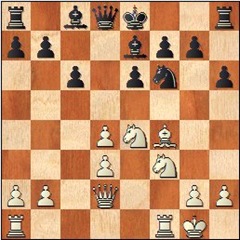
and now Black felt that he only had to exchange a few more pieces before winning the ending with his extra pawn, his better pawn structure, and his pair of Bishops, so he played 12...Nd5? which of course is met by 13.Ne5 Now, 13 ... Nxf4 14.Qxf4 would be suicide, and the only move preventing an immediate disaster is the sad retreat 13...Nf6 but after 14.Qf2 White has a tremendous position.

Now we have examined some types of blunders, but we still have to explain why these blunders should be provoked by the BDG more than by most other openings. The answer to that, I think, is closely connected to the question: what makes some players better than others? One answer could be (Hartston / Wasen: The Psychology of Chess, p.55): "The skill of a master is assumed to be basically one of 'pattern recognition'" (rather than a skill of calculating many moves ahead/njj). The consequences of this are met in the highly recommended book, Chess for Tigers, by Simon Webb, where the author advises (p. 40) how one should play against "Heffalurnps" (very strong players): "Randomize! … so if you see a line which is difficult to judge, give it a try." (i.e., positions. where your opponent. cannot see any "normal" patterns/njj). "The sorts of positions which are particularly difficult to judge are those with a material imbalance, such as queen for two rooks, two minor pieces for a rook, the exchange for a pawn or two." In this category would also belong positions with initiative for a pawn, a strong attack for a piece, etc.--in short, the BDG!
One more thing pulls in this same direction: as pointed out by Tarrasch, who was a doctor as well as a chess master, an unforeseen sacrifice tends to arouse a state of shock in the opponent, disturbing his ability for calm and correct calculation. This state of shock, which might arise even when the gambit pawn is offered, then increases the possibility of the fault-provoking images dealt with above, since the ability of the player to overcome the gap between the position on the board and the one reached in calculation is reduced radically when he cannot recognize his usual patterns. Accordingly, the White chances will increase, simply because sacrifices on f7, Canal mates, etc., are standard patterns of every BDG player.
So--should the BDG not be "correct" (and I believe it is!), I think that any lack of "correctness" is more than offset by the psychological advantages it gives its supporters. I am sure you agree with the German player who called the BDG “Panneverdächtig” --blunder provoking.
Play through and download PGN games here.
Over the years Niels Jørgen Jensen, of Copenhagen, contributed many articles and games to BDG World. Here is his first article we published, from the January/February issue of our third year, 1985.
We all know that if we let our opponent face a BDG we are more likely to finish him off quickly and brutally than if we play another opening, say the Queen's Gambit. Why is that so? What is it in the BDG that literally provokes our opponent to commit blunders? Well, to a certain extent it can be explained.
If we accept the fact that blunders do not appear totally haphazardly, it becomes clear that the answer must be closely connected to psychology. Chess is a mental struggle, and so chess blunders must be looked upon as psychological phenomena. Let us take a look at various categories of black faults and try to explain them. First, a game as study material:
Niels Jørgen Jensen - Steen Lynesskjold
Team Match, 1984
BDG (from Caro-Kann)
1.d4 d5 2.e4 Here my opponent sighed, "Blackmar-Diemer," thought for about five minutes, shook his head determinedly and played: 2...c6 3.Nc3 dxe4 4.Bc4 Nf6 5.f3 And now he realized that he had been fooled. Ten minutes thought. 5...exf3 6.Nxf3

6...e6 [Some people just don't play the obvious: 6...Bf5 ] 7.0-0 b5 8.Bd3 Nbd7 9.Qe1

Preparing for Qg3 or Qh4. I wouldn't develop my Bc1 until Black had had his chance to misplace his Bf8. 9...Be7 10.Ng5 b4 11.Nce4 a5 12.Nxf7 Kxf7 13.Ng5+ Ke8 14.Qxe6 Rf8 15.Nxh7 1-0

As you will admit, Black defended poorly. However, he is no weak player, and his weak moves do not occur incidentally but--as we shall see--can be psychologically explained.
In his excellent book, Psychology in Chess, the Russian GM Krogius distinguishes between three different types of blunders, which are all present in the above game:
1. The forward image occurs when the player transfers positions reached in his calculations or moves which have not yet been played to the actual position on the board. As Krogius expresses it: “The future possibilities become an obsession and are treated as real factors in the assessment of the current position.” Thus the player in whom a forward image has arisen tends to exaggerate threats. In the game above, the move 6…e6? is the result of such a forward image. Black knows that the BDG is a very sharp opening, he may fear a Bxf7+, and in his imagination he already sees an overwhelming attack with Ng5+ and Qf3--moves which in his mind are accepted as real. Perhaps he also sees the "ghosts" 6…Bg4? 7.Ne5 or 6…Bf5 7.0-0 followed by Ng5/Nxf7/Rxf5. At any rate, he decides on the "safe" 6…e6?, preventing the impossible sacrifice on f7. If you search your BDG literature (Freidl II, e.g.), you will find several similar moves, indicating that we are dealing with a common psychological pattern.
2. The retained image is the opposite of the forward image. Whereas the forward image leads to exaggerations of future possibilities, the retained image tends to narrow down the perception of the chess player, who plans his moves from a starting point which has become static, thus repressing the dynamic aspects of the position.
I think Krogius's retained image should be divided into two distinct subcategories:
a) Positions or possibilities previous in the game still influence the player's perception of the actual position on the board. After my game with Lynesskjold, he told me that he had not seen the possibility of 12.Nxf7 at all, a statement which at first seems amazing--after all Nxf7 is probably the most evident move in the entire game, so how could he miss it? The answer is really simple: once he had seen the possibility of a sacrifice on f7 (namely Bxf7), he had prevented it by 6 … e6. Furthermore, with 7 … b5 he had driven away the Bishop from the diagonal, so from moves 7 -12 in his mind a sacrifice on f7 was impossible. The board had changed, but the idea that a sacrifice had been prevented remained. As Krogius expresses it: “In this way the past continues its activity into the present to the extent of edging out reality.”
b) Elements in the position on the board become static and are transferred in an unaltered form to future lines reached in calculation. An example of this kind of retained image is found in the following game:Jan Sandahl – Emborg
Denmark, 1984
Lemberger Counter Gambit
1.d4 d5 2.e4 dxe4 3.Nc3 e5 4.Nxe4 Qxd4 5.Bd3 Nc6 6.Nf3 Qb6 7.0-0 Bg4 8.h3 Bxf3 9.Qxf3 Nd4 10.Qh5 Bd6 11.Be3

11...Qc6? 12.Bxd4 exd4 13.Bb5 1-0
The blunder 11 … Qc6? can only be explained by the second type of the retained image: the e5-pawn firmly separates the Qh5 from the crucial square b5 and blocks Black's imagination of the possibilities after a possible removal of the pawn.
3. Krogius's third category of faults arises from the recalled inert image. This image may arise when a player, trying to carry out a plan, fails to realize that the position on the board might have changed in a way which was not foreseen. The player fails to notice the dynamic powers of the position. Again as a first example my game above; after having played 6 … e6, Black must find another way to develop his Bc8, and as he finds 0-0 too dangerous before the Bd3 has been exchanged, he plans to play b4/a5/Ba6, but as he finally reaches the point where he is ready to play Ba6, the position has changed and is already lost for him.
As Krogius points out, the inert image often arises when a player is satisfied with his position and thinks that the game is already won for him. Probably this is the reason why the inert image is a very common cause for Black blunders against the BDG: one pawn up, Black often mechanically tries to exchange pieces, underestimating the dynamic power of the White position. Another example:
Erich Müller - N. J. Jensen
Correspondence, 1984/85
BDG, Euwe Defense
1.d4 d5 2.e4 dxe4 3.Nc3 Nf6 4.f3 exf3 5.Nxf3 e6 6.Bg5 Be7 7.Bd3 Nc6 8.Qd2 h6 9.Bf4 Nb4

If this is not correct, then the frequently played 8.a3 is a waste of time. Now the first exchange costs Black a tempo. 10.0-0 Nxd3 11.cxd3 c6 12.Ne4

and now Black felt that he only had to exchange a few more pieces before winning the ending with his extra pawn, his better pawn structure, and his pair of Bishops, so he played 12...Nd5? which of course is met by 13.Ne5 Now, 13 ... Nxf4 14.Qxf4 would be suicide, and the only move preventing an immediate disaster is the sad retreat 13...Nf6 but after 14.Qf2 White has a tremendous position.

Now we have examined some types of blunders, but we still have to explain why these blunders should be provoked by the BDG more than by most other openings. The answer to that, I think, is closely connected to the question: what makes some players better than others? One answer could be (Hartston / Wasen: The Psychology of Chess, p.55): "The skill of a master is assumed to be basically one of 'pattern recognition'" (rather than a skill of calculating many moves ahead/njj). The consequences of this are met in the highly recommended book, Chess for Tigers, by Simon Webb, where the author advises (p. 40) how one should play against "Heffalurnps" (very strong players): "Randomize! … so if you see a line which is difficult to judge, give it a try." (i.e., positions. where your opponent. cannot see any "normal" patterns/njj). "The sorts of positions which are particularly difficult to judge are those with a material imbalance, such as queen for two rooks, two minor pieces for a rook, the exchange for a pawn or two." In this category would also belong positions with initiative for a pawn, a strong attack for a piece, etc.--in short, the BDG!
One more thing pulls in this same direction: as pointed out by Tarrasch, who was a doctor as well as a chess master, an unforeseen sacrifice tends to arouse a state of shock in the opponent, disturbing his ability for calm and correct calculation. This state of shock, which might arise even when the gambit pawn is offered, then increases the possibility of the fault-provoking images dealt with above, since the ability of the player to overcome the gap between the position on the board and the one reached in calculation is reduced radically when he cannot recognize his usual patterns. Accordingly, the White chances will increase, simply because sacrifices on f7, Canal mates, etc., are standard patterns of every BDG player.
So--should the BDG not be "correct" (and I believe it is!), I think that any lack of "correctness" is more than offset by the psychological advantages it gives its supporters. I am sure you agree with the German player who called the BDG “Panneverdächtig” --blunder provoking.
Play through and download PGN games here.
Sunday, March 8, 2009
Master and Grandmaster, BDG and Caro-Kann
I haven't posted anything for a while. Linares has taken all my allotment of chess time. It finished up yesterday, with GM Vassily Ivanchuk, who first won the tourney 18 years ago, and GM Alexander Grischuk tied with eight points in 14 rounds. Grischuk had three wins to Ivanchuk's two and that was used to break the tie, rather than the more usual S/B system. I watched the games live online and gained a new appreciation for the veteran Ivanchuk.
But back to the the Blackmar-Diemer. Peter Webster was the first master I ever heard of who frequently played the BDG. He quit tournament play years ago for health reasons. But here's an interesting game from one of his simultaneous exhibitions.
Peter B. Webster - Anonymous
Elm Grove WI simul, 1988
BDG, Teichmann Defense
1. d4 d5 2. e4 dxe4 3. Nc3 Nf6 4. f3 exf3 5. Nxf3 Bg4 6. h3 Bh5 7. g4 Bg6 8. Bg2 e6 9. Ne5 c6 10. h4 h5?

This position is also reached in the Gunderam Defense after 1. d4 d5 2. e4 dxe4 3. Nc3 Nf6 4. f3 exf3 5. Nxf3 Bf5 6. Ne5 e6 7. g4 Bg6 8.Bg2 c6 9. h4 h5?
11. Nxg6 fxg6 12. Qd3 Kf7?

13. g5 Ng4 14. Be4 Bd6 15. Bxg6+ Kg8 16. Ne4 Qc7 17. O-O Nd7 18. Bf7+ Kf8 19. Bxe6+ Ke7 20. Rf7+ Kxe6 21. Qb3# 1-0

The Webster game is entertaining on its own, but I wanted to show it here to compare it with some of the themes in this game by the big guys:
Karpov, Anatoly - Hort, Vlastimil
Bugojno, 1978
Caro-Kann
1. e4 c6 2. d4 d5 3. Nd2 dxe4 4. Nxe4 Nd7 5. Nf3 Ngf6 6. Nxf6+ Nxf6 7. Ne5 Bf5 8. c3 e6 9. g4 Bg6 10. h4 h5?

11. g5 Nd5 12. Nxg6 fxg6 13. Qc2 Kf7?

14. Rh3 Ne7 15. Bc4 Nf5 16. Rf3 Qd7 17. Rxf5+ gxf5 18. Qxf5+ Ke7 19. Qe4 Re8 20. Bf4 Kd8 21. Qe5 Rg8 22. O-O-O g6 23. Re1 Bg7 24. Qb8+ Ke7 25. Rxe6+ 1-0

In both games Black made similar errors, h7-h5?, leading to the white square weakness, and then Kf7?, trying to hold the g6-pawn. Karpov had to run the Rook up to h3 to get it over to the f-file, but since the f-file was already open in the BDG, Webster could get it there in one move by castling. There are other similiarities and differences, but I'm too tired from watching Linares to mention them.
But back to the the Blackmar-Diemer. Peter Webster was the first master I ever heard of who frequently played the BDG. He quit tournament play years ago for health reasons. But here's an interesting game from one of his simultaneous exhibitions.
Peter B. Webster - Anonymous
Elm Grove WI simul, 1988
BDG, Teichmann Defense
1. d4 d5 2. e4 dxe4 3. Nc3 Nf6 4. f3 exf3 5. Nxf3 Bg4 6. h3 Bh5 7. g4 Bg6 8. Bg2 e6 9. Ne5 c6 10. h4 h5?

This position is also reached in the Gunderam Defense after 1. d4 d5 2. e4 dxe4 3. Nc3 Nf6 4. f3 exf3 5. Nxf3 Bf5 6. Ne5 e6 7. g4 Bg6 8.Bg2 c6 9. h4 h5?
11. Nxg6 fxg6 12. Qd3 Kf7?

13. g5 Ng4 14. Be4 Bd6 15. Bxg6+ Kg8 16. Ne4 Qc7 17. O-O Nd7 18. Bf7+ Kf8 19. Bxe6+ Ke7 20. Rf7+ Kxe6 21. Qb3# 1-0

The Webster game is entertaining on its own, but I wanted to show it here to compare it with some of the themes in this game by the big guys:
Karpov, Anatoly - Hort, Vlastimil
Bugojno, 1978
Caro-Kann
1. e4 c6 2. d4 d5 3. Nd2 dxe4 4. Nxe4 Nd7 5. Nf3 Ngf6 6. Nxf6+ Nxf6 7. Ne5 Bf5 8. c3 e6 9. g4 Bg6 10. h4 h5?

11. g5 Nd5 12. Nxg6 fxg6 13. Qc2 Kf7?

14. Rh3 Ne7 15. Bc4 Nf5 16. Rf3 Qd7 17. Rxf5+ gxf5 18. Qxf5+ Ke7 19. Qe4 Re8 20. Bf4 Kd8 21. Qe5 Rg8 22. O-O-O g6 23. Re1 Bg7 24. Qb8+ Ke7 25. Rxe6+ 1-0

In both games Black made similar errors, h7-h5?, leading to the white square weakness, and then Kf7?, trying to hold the g6-pawn. Karpov had to run the Rook up to h3 to get it over to the f-file, but since the f-file was already open in the BDG, Webster could get it there in one move by castling. There are other similiarities and differences, but I'm too tired from watching Linares to mention them.
Wednesday, October 15, 2008
Transpositions: From the Caro-Kann to the BDG (Update)
In my last post I gave the opening moves of the game von Hennig - van Nüss, a transposition from the Caro-Kann to the Blackmar-Diemer. Here's the complete score.
von Hennig,Heinrich - van Nüss,Alfred
1929
Caro-Kann to BDG, Euwe Defense
1.e4 c6 2.d4 d5 3.Nc3 dxe4 4.Bc4 Nf6 5.f3 exf3 6.Nxf3 e6 7.0-0 Be7

8.Qe2 Nbd7 9.Bf4 0-0 10.Rad1 Nb6 11.Bb3 Nbd5 12.Be5 Bd7 13.Ng5 Be8 14.Rd3 Nxc3 15.bxc3 h6 16.Nh3 g6 17.Rg3 Nd7 18.Bf4 Kg7 19.Qd2 Rh8 20.Be3 Qa5 21.Nf4 Nf8 22.d5 h5 23.Bd4+ f6 24.d6!

24...Bd8

38.Qh6+ 1-0
Purser,Tom (1780) - Lewie,David (2030)
American Legion Open
Fairborn, Ohio, 1981
Caro-Kann to BDG, Euwe Defense
1.d4 c6 2.e4 d5 3.Nc3 dxe4 4.Bc4 e6 5.f3 exf3 6.Nxf3 Nf6 7.0-0 Be7


19.Rxf5! exf5??

von Hennig,Heinrich - van Nüss,Alfred
1929
Caro-Kann to BDG, Euwe Defense
1.e4 c6 2.d4 d5 3.Nc3 dxe4 4.Bc4 Nf6 5.f3 exf3 6.Nxf3 e6 7.0-0 Be7

8.Qe2 Nbd7 9.Bf4 0-0 10.Rad1 Nb6 11.Bb3 Nbd5 12.Be5 Bd7 13.Ng5 Be8 14.Rd3 Nxc3 15.bxc3 h6 16.Nh3 g6 17.Rg3 Nd7 18.Bf4 Kg7 19.Qd2 Rh8 20.Be3 Qa5 21.Nf4 Nf8 22.d5 h5 23.Bd4+ f6 24.d6!

24...Bd8
24...Bxd6?? The passed d-pawn will prove decisive, but taking it would be disastrous. 25.Bxf6+ Kg8 (25...Kxf6?? 26.Nxg6+) 26.Qxd6+-25.Nxe6+ Nxe6 26.Bxe6 c5 27.Be3 h4 28.Rgf3 Bc6 29.Bd5 Rh5 30.Bxc6 bxc6 31.Qf2 Qxa2? 32.Rxf6 Bxf6 33.Qxf6+ Kh7 34.Qe7+ Kh8 35.d7 Qg8
35...Rf5 36.d8Q+ Rxd8 37.Qxd8+ Kg7 38.Rxf5 gxf5 39.Qg5++-36.Bg5 Rxg5 37.Qxg5 Qd5

38.Qh6+ 1-0
Simpler was 38.Qxd5 cxd5 39.Re1While searching for the complete score today I came across one of my old games with this variation. Indulge me.
Purser,Tom (1780) - Lewie,David (2030)
American Legion Open
Fairborn, Ohio, 1981
Caro-Kann to BDG, Euwe Defense
1.d4 c6 2.e4 d5 3.Nc3 dxe4 4.Bc4 e6 5.f3 exf3 6.Nxf3 Nf6 7.0-0 Be7

So far as in the previous game.8.Qe1 Nbd7 9.Bd3 c5 10.Qg3 cxd4 11.Nb5 Kf8 12.Nc7 Nh5 13.Nxe6+ fxe6 14.Nxd4+ Ndf6 15.Qh4 g6 [15...e5] 16.Bh6+ Ng7 17.Nf3?! Kg8 18.Ne5 Nf5?

19.Rxf5! exf5??
Allows a forced mate. Best was 19...Nd5 20.Rg5+/-20.Bc4+ Nd5 21.Bxd5+ Qxd5 22.Qxe7 1-0

Monday, October 13, 2008
Transpositions: From the Caro-Kann to the BDG
One well-known transposition to the Blackmar-Diemer comes via the Caro-Kann.
In Georg Studier's 1966 biography of E. J. Diemer he discusses the scarcity of Blackmar-Diemer Gambit games during the first three decades of this century, and fills the gap with a few such transpositions.
As his earliest example he gives this game:
V. Hennig - van Nüss
(where?) 1929
1.e4 c6 2.d4 d5 3.Nc3 dxe4 4.Bc4 Nf6 5.f3 exf3 6.Nxf3 e6
 The position reached occurs in the Euwe Defense to the BDG after 1.d4 d5 2.e4 dxe4 3.Nc3 Nf6 4.f3 exf3 5.Nxf3 e6 6.Bc4 c6. (This actually also reaches a line in the Ziegler Defense (5...c6) to the BDG a half-move earlier--the Ziegler is such a chameleon, transposing into many of the more common BDG variations.)
"The game ended on the 38th move with a White victory," writes Studier, giving no more moves. His source was Rolf Schwarz in Band 22 of his Handbuch der Schacheroeffnungen, 1966 edition (Schach-Archiv, Hamburg).
In my database I find an earlier example of this transposition:
von Hennig - Carls
Goteborg II (7), 1920
Caro-Kann to BDG Euwe Defense [B15]
1.e4 c6 2.d4 d5 3.Nc3 dxe4 4.Bc4 Nf6 5.f3 exf3 6.Nxf3 e6 7.0-0 Be7 8.Ne5 Nbd7 9.Qe2 0-0 10.Be3 Qc7 11.Bf4 Bd6 12.Rad1 Nd5 13.Bg3 N7f6 14.Bh4 Be7 15.Rd3 Ne8 16.Bg3 Qd8 17.Rdf3 f5 18.Nxd5 cxd5 19.Bd3 Nf6 20.Bh4 Nd7 21.Nxd7 Bxd7 22.Bxe7 Qxe7 23.Bxf5 Qd6 24.Bd3 g6 25.Qe5 Qxe5 26.Rxf8+ Rxf8 27.Rxf8+ Kxf8 28.dxe5 Kg7 29.h4 h6 30.Kf2 g5 31.Kg3 Be8 32.Kg4 gxh4 33.Kxh4 Bf7 34.g4 ½-½
I presume the players in this game were Heinrich von Hennig (1883-1947) and Carl Johan Margot Carls (1880-1958). (The dates are from Jeremy Gaige's invaluable Chess Personalia.) I think the same v. Hennig plays White in both games.
The position reached occurs in the Euwe Defense to the BDG after 1.d4 d5 2.e4 dxe4 3.Nc3 Nf6 4.f3 exf3 5.Nxf3 e6 6.Bc4 c6. (This actually also reaches a line in the Ziegler Defense (5...c6) to the BDG a half-move earlier--the Ziegler is such a chameleon, transposing into many of the more common BDG variations.)
"The game ended on the 38th move with a White victory," writes Studier, giving no more moves. His source was Rolf Schwarz in Band 22 of his Handbuch der Schacheroeffnungen, 1966 edition (Schach-Archiv, Hamburg).
In my database I find an earlier example of this transposition:
von Hennig - Carls
Goteborg II (7), 1920
Caro-Kann to BDG Euwe Defense [B15]
1.e4 c6 2.d4 d5 3.Nc3 dxe4 4.Bc4 Nf6 5.f3 exf3 6.Nxf3 e6 7.0-0 Be7 8.Ne5 Nbd7 9.Qe2 0-0 10.Be3 Qc7 11.Bf4 Bd6 12.Rad1 Nd5 13.Bg3 N7f6 14.Bh4 Be7 15.Rd3 Ne8 16.Bg3 Qd8 17.Rdf3 f5 18.Nxd5 cxd5 19.Bd3 Nf6 20.Bh4 Nd7 21.Nxd7 Bxd7 22.Bxe7 Qxe7 23.Bxf5 Qd6 24.Bd3 g6 25.Qe5 Qxe5 26.Rxf8+ Rxf8 27.Rxf8+ Kxf8 28.dxe5 Kg7 29.h4 h6 30.Kf2 g5 31.Kg3 Be8 32.Kg4 gxh4 33.Kxh4 Bf7 34.g4 ½-½
I presume the players in this game were Heinrich von Hennig (1883-1947) and Carl Johan Margot Carls (1880-1958). (The dates are from Jeremy Gaige's invaluable Chess Personalia.) I think the same v. Hennig plays White in both games.

Wednesday, August 6, 2008
More about Kampars (and Fischer)
In 1957 Nick Kampars played a young Bobby Fischer in the New Western Open in Milwaukee. The luck of the draw gave Kampars the black pieces--otherwise we might have had a game with the future world champion defending against the Blackmar-Diemer Gambit.
Fischer,RJ - Kampars,N [B11] 1034 Milwaukee, New Western Open, 1957
1.e4 c6 2.Nc3 d5 3.Nf3 Bg4
 Kampars plays sharply against the Caro Kann Two Knights. Within a couple of years after this game his opponent was facing the likes of Keres, Petrosian, Smyslov, and Larsen in the same line.
4.h3 Bxf3 5.Qxf3 e6 6.d4 Nd7 7.Bd3 dxe4 8.Nxe4 Ngf6 9.0-0 Nxe4 10.Qxe4 Nf6 11.Qe3 Nd5 12.Qf3 Qf6 13.Qxf6 Nxf6 14.Rd1 0-0-0 15.Be3 Nd5 16.Bg5 Be7 17.Bxe7 Nxe7 18.Be4 Nd5 19.g3 Nf6 20.Bf3 Kc7 21.Kf1 Rhe8 22.Be2 e5 23.dxe5 Rxe5 24.Bc4 Rxd1+ 25.Rxd1 Re7 26.Bb3 Ne4 27.Rd4 Nd6 28.c3 f6 29.Bc2 h6 30.Bd3 Nf7 31.f4 Rd7 32.Rxd7+ Kxd7 33.Kf2 Nd6 34.Kf3 f5 35.Ke3 c5 36.Be2 Ke6 37.Bd3 Drawn.
Fischer finished with 6 of a possible 8 points in a strong field. Larry Evans and Donald Byrne shared first with 7, and another Latvian, Paul (Povilas) Tautvaisas came in with 6.5 points. Yes, this is the same Tautvaisas who turned back Diemer's BDG at Esslingen, Germany in 1948 (Game 70a in Diemer's book). Fischer's only loss was to Mel Otteson (who was on the losing side of a BDG we previously published--Game 702 in BDG World).
The next year Fischer was a grandmaster. As for Kampars, I don't know how he finished in the tournament. But a draw with Black against Bobby Fischer, yes, even a young Bobby Fischer, is good enough for me.
Fischer,RJ - Kampars,N [B11] 1034 Milwaukee, New Western Open, 1957
1.e4 c6 2.Nc3 d5 3.Nf3 Bg4
 Kampars plays sharply against the Caro Kann Two Knights. Within a couple of years after this game his opponent was facing the likes of Keres, Petrosian, Smyslov, and Larsen in the same line.
4.h3 Bxf3 5.Qxf3 e6 6.d4 Nd7 7.Bd3 dxe4 8.Nxe4 Ngf6 9.0-0 Nxe4 10.Qxe4 Nf6 11.Qe3 Nd5 12.Qf3 Qf6 13.Qxf6 Nxf6 14.Rd1 0-0-0 15.Be3 Nd5 16.Bg5 Be7 17.Bxe7 Nxe7 18.Be4 Nd5 19.g3 Nf6 20.Bf3 Kc7 21.Kf1 Rhe8 22.Be2 e5 23.dxe5 Rxe5 24.Bc4 Rxd1+ 25.Rxd1 Re7 26.Bb3 Ne4 27.Rd4 Nd6 28.c3 f6 29.Bc2 h6 30.Bd3 Nf7 31.f4 Rd7 32.Rxd7+ Kxd7 33.Kf2 Nd6 34.Kf3 f5 35.Ke3 c5 36.Be2 Ke6 37.Bd3 Drawn.
Fischer finished with 6 of a possible 8 points in a strong field. Larry Evans and Donald Byrne shared first with 7, and another Latvian, Paul (Povilas) Tautvaisas came in with 6.5 points. Yes, this is the same Tautvaisas who turned back Diemer's BDG at Esslingen, Germany in 1948 (Game 70a in Diemer's book). Fischer's only loss was to Mel Otteson (who was on the losing side of a BDG we previously published--Game 702 in BDG World).
The next year Fischer was a grandmaster. As for Kampars, I don't know how he finished in the tournament. But a draw with Black against Bobby Fischer, yes, even a young Bobby Fischer, is good enough for me.
Subscribe to:
Posts (Atom)
